Yajna
The broader Vedic principle of sacred offering, participation and reciprocity.
A beginner's journey into sacred fire
Understand the purpose, tradition, ingredients and preparation of Havan before choosing a formulation.
Start learning01
Begin with the meaning
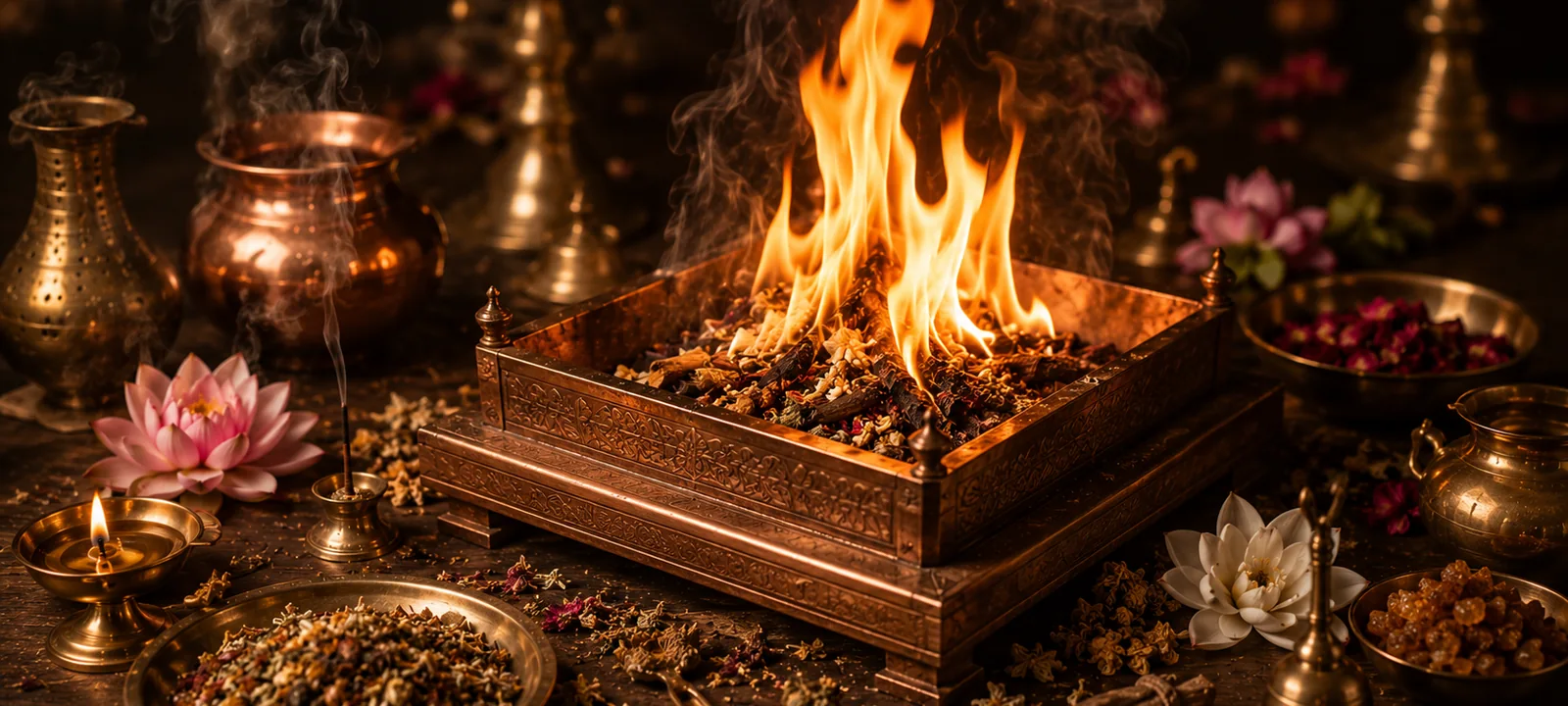
Havan is a sacred fire offering: a practice in which prayer, intention and natural materials are offered into Agni.
The broader Vedic principle of sacred offering, participation and reciprocity.
A fire ritual performed through a defined sequence of invocations and offerings.
A widely used name for the sacred fire practice, especially in household worship.
Each offering placed into the fire with a mantra, prayer or devotional intention.
Why fire? In the ritual understanding, Agni receives the visible offering and carries the act of offering beyond itself. The flame also asks for attention: an offering cannot be made absent-mindedly.
02
Purpose comes first
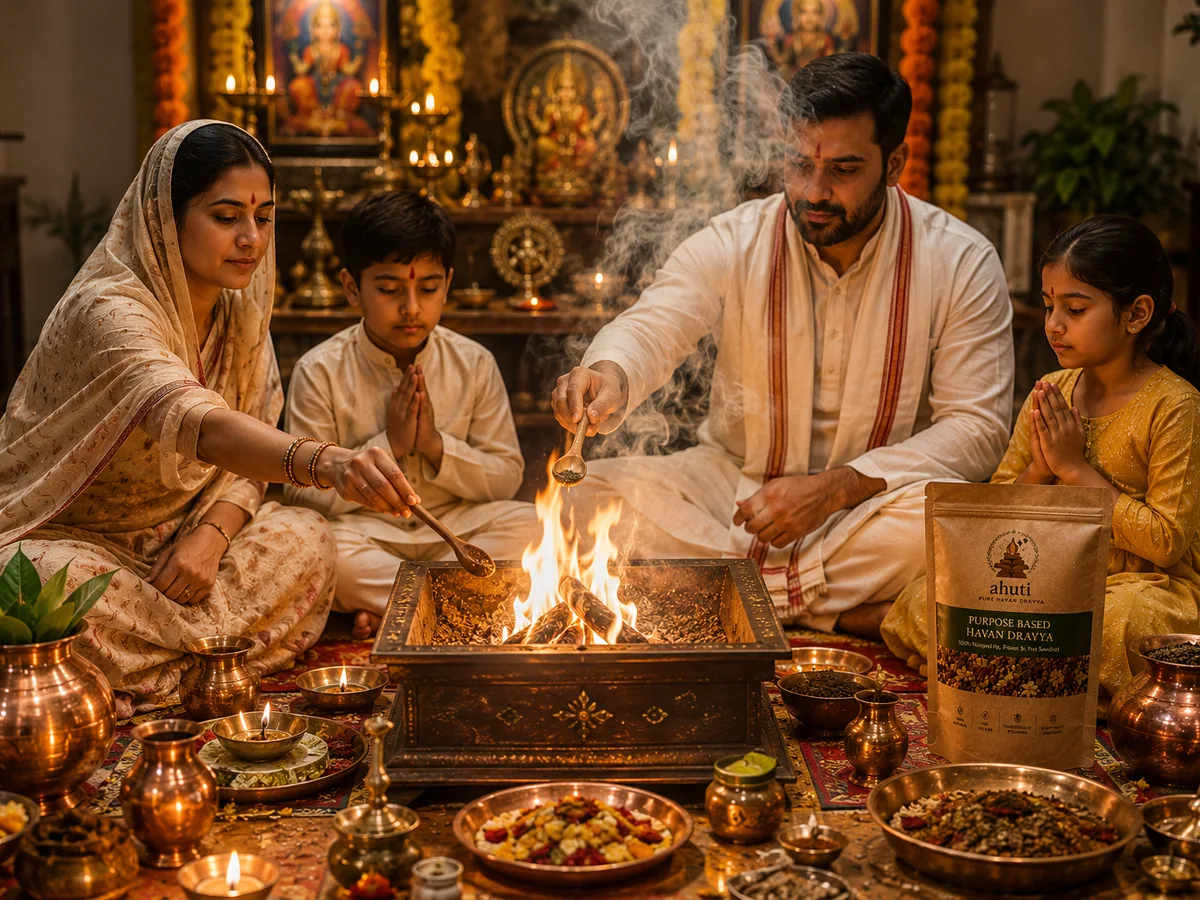
Havan may mark daily worship, gratitude, spiritual discipline, festivals, family ceremonies, sanskar, prayer or purification. The outer form can look similar, while the purpose may be entirely different.
That purpose is held in the sankalpa: the clear intention with which the practice begins. It guides the prayer, the method and, where tradition prescribes it, the ingredients that are offered.
03
The anatomy of an offering
Not everything near the Havan kund serves the same role. Understanding the parts makes the practice easier to follow.
Selected wood used as fuel. It establishes and sustains Agni; it is distinct from the offering mixture.
Clarified butter used in measured amounts according to the method being followed.
Materials such as barley and sesame appear in many traditional offering compositions.
Botanical materials and natural resins are selected for their place in a particular preparation.
Some rites include purpose-specific materials rather than one universal mixture.
04
Nothing is merely decorative
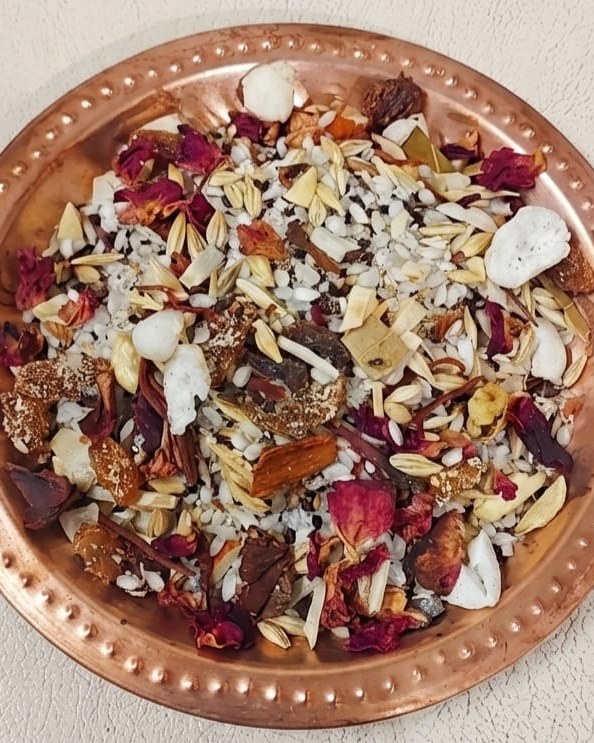
A Havan preparation can bring together grains for nourishment, seeds used across ceremonial traditions, aromatic herbs, fragrant woods, natural resins and sweet dravya. Their value lies not in how many are present, but in why they are there.
Barley and sesameFoundational grain and seed offerings used across many practices.
Guggul and fragrant woodsAromatic materials included with restraint and purpose.
Lotus seed and flowersMaterials whose symbolism may belong to specific devotional contexts.
05
One fire, many contexts
A daily household Havan is not the same undertaking as a Ganapati Homa, a Navagraha prayer or a family sanskar. Tradition preserves distinctions because the intention, invocation and ritual context differ.
This does not mean every home practice needs a complex preparation. It means that when a rite has a defined tradition, its materials should be chosen with that context in mind.
06
Knowing what you offer
Recognition creates a direct relationship with the offering. A grain can still be known as a grain; a seed, resin or flower can retain its identity.
Visibility supports trust, but it also supports understanding. It allows the person performing Havan to see what is being placed into the fire and to remember that a formulation is composed of distinct natural materials, not an anonymous substance.

07
Care before the flame
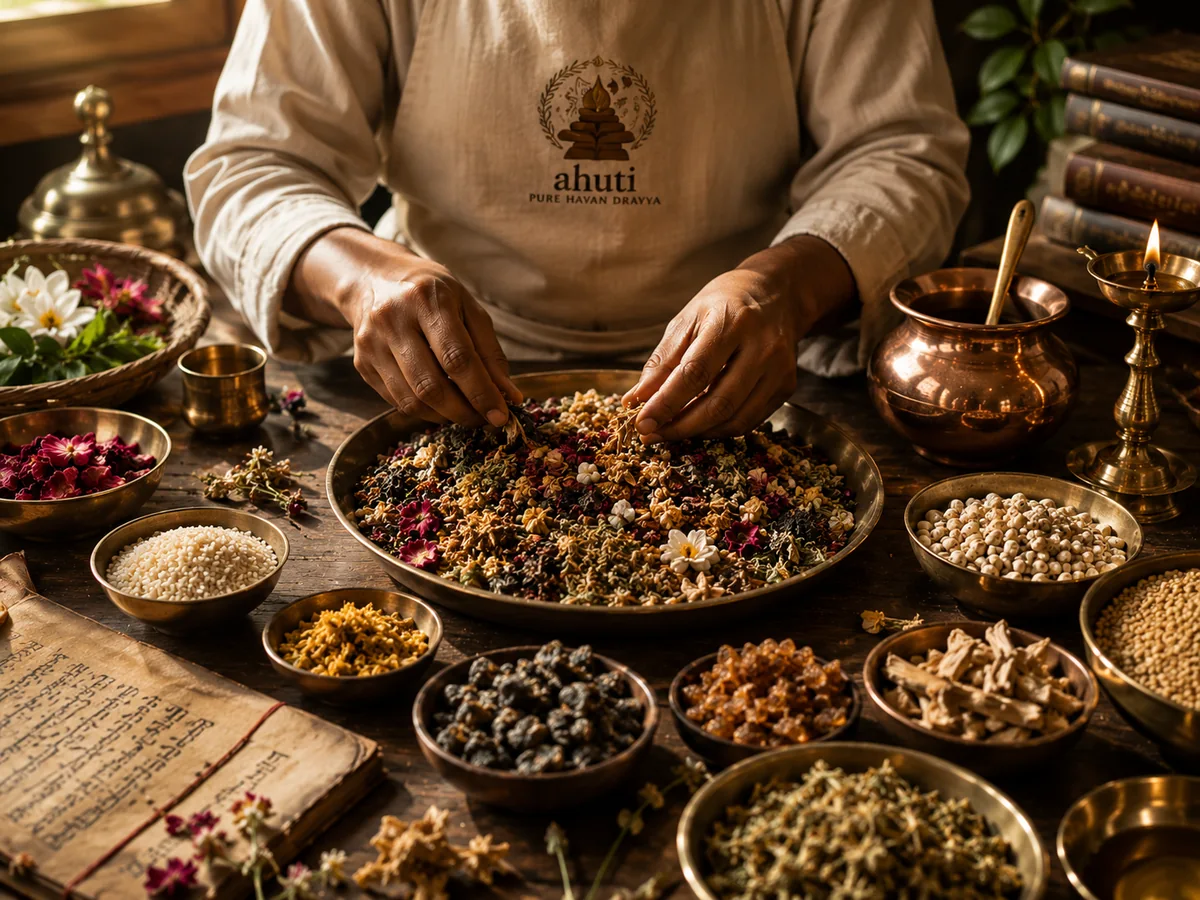
The integrity of a preparation is shaped long before it reaches the Havan kund.
Choose materials appropriate to the ritual context.
Remove dust and unsuitable matter with care.
Protect ingredients from excess moisture before blending.
Preserve recognisable form wherever the material permits.
Bring the ingredients together in considered proportions.
Protect the preparation from contamination and humidity.
Use a small, appropriate amount with attention.
08
A gentle starting point
This is a simplified orientation for personal household practice, not a substitute for a family, sampradaya or priest-led procedure.
Use a stable, fire-safe Havan kund in a ventilated area. Keep water or sand nearby, clear loose fabrics and never leave the flame unattended.
Arrange suitable samidha and light it carefully. Keep the flame modest; smoke is not the purpose of Havan.
Settle your attention and state the intention of the practice. Follow the prayers or mantras taught in your tradition.
Place a small pinch of dravya with each mantra or prayer. Avoid overfeeding the flame or adding unknown materials.
Complete the prayer, allow the fire to settle, and ensure every ember is safely extinguished before leaving the space.
09
Common assumptions, reconsidered
Four distinctions make the practice easier to understand.
Myth
Reality
Household practice, deity-focused Homa and sanskar may call for different materials and procedures.
Myth
Reality
The aim is a tended sacred fire and attentive offering, not filling the room with smoke.
Myth
Reality
Suitability and proportion matter more than an impressive ingredient count.
Myth
Reality
It may be part of regular household worship as well as festivals, ceremonies and focused observances.
10
A living body of practice
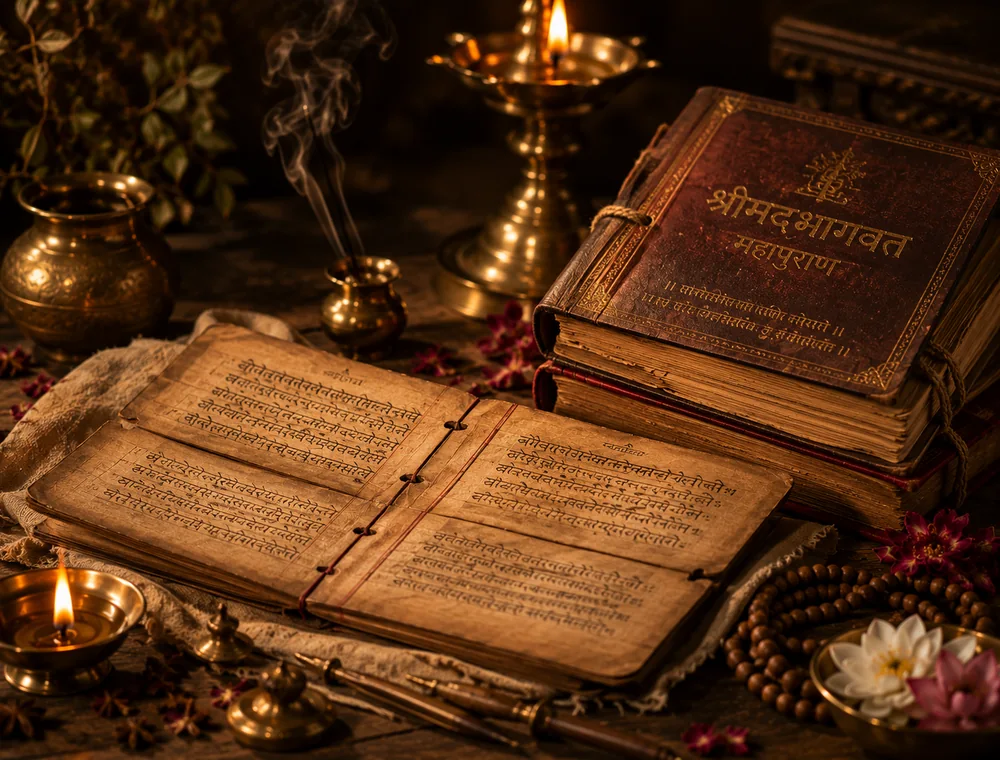
Fire offering has deep roots in the Vedas and develops through a wide body of ritual literature and living practice. The Grihya Sutras describe domestic rites; Smriti and Puranic traditions contribute later frameworks; temple and regional traditions preserve their own procedures.
There is therefore no single short passage that explains every Havan. A practice should be understood through its purpose, textual context and the tradition in which it is performed.
11
Your next chapter
Move from first principles to the question that matters to your own practice.